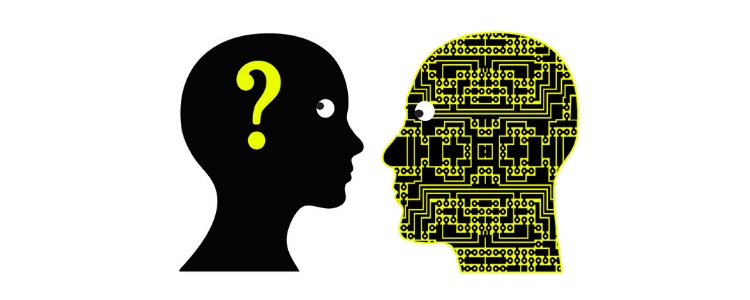
Like predators, autistics naturally make eye contact exclusively when they are in a conflict. When you encounter someone who makes no eye contact and you swear at them and they look at you angrily, then you have recognized an autistic person. Teachers could perform this diagnosis very easily, were it not that mental health services keep this information secret.
Neurotypicals have an innate language center, start babbling at age 2, and by age 5 have mastered enough vocabulary to hold conversations. Autistics discover around age 3 that some sounds are more important than others and start listening to the conversations taking place around them. By age six, they have picked up enough vocabulary to start talking. By age seven, they can start holding conversations.
People must master four basic skills to be able to hold conversations, ask for help, and file complaints.
Children go through a curious phase at age five. During this phase, neurotypical children learn the first three skills on their own initiative. They learn the fourth skill from their parents at age eight. Autistic children could learn the first three skills at school at age seven.
But apparently, psychologists in the last 80 years have never discovered that you need skills to hold a conversation. In 2016, I investigated why people always walked away in the middle of my story and discovered these skills within a month. It took just over a year to learn how to apply the skills. (People with high levels of intellectual disability likely need help to be able to learn these skills).
To be able to hold conversations, to ask for help, and to complain: You must be able to recognize whether people are listening to you, recognize whether they are interested, recognize whether they have understood you, and be able to deal with communication errors and avoid conflicts.
- When people are not looking at you, they are not listening. In 99% of cases, the nose points in the same direction as the eyes. So it is quite possible to see where people are looking without having to make eye contact.
- When a neurotypical looks up and yawns, he is not interested.
- When someone’s facial expression changes to something that aligns with your story, then he has understood you. Research shows that autistic people recognize facial expressions twice as fast as neurotypicals.
- If someone says something strange, he is making a joke, laugh. In verbal communication, there is a 30% chance that a message is misinterpreted and causes a conflict. By laughing, you prevent conflict.
- (Neurotypicals look at the eyes because that is the calmest part of the face. But at the same time, it evokes a feeling of aggression. When an autistic person does not smile when looking at a neurotypical, the neurotypical may feel that the autistic person is angry. Neurotypicals have a smile reflex. Autistic people do not.)
Autistic people suffer from severe panic attacks throughout their lives. These turn out to have a very simple cause.
(In my youth, children went to school at age six.) A neurotypical six-year-old goes to school for the first time. He feels like he needs to go to the toilet, but nothing comes out. His mother asks him if he is nervous. An autistic six-year-old goes to school for the first time and has a strange feeling in his groin. He can talk but is not yet able to hold conversations, so his parents cannot explain to him what is going on. Neurotypical children encounter many thousands of problems in their early childhood and teenage years that they solve with the help of their parents. Autistic children encounter those same thousands of problems. But because they are not taught the skills needed to hold a conversation, their parents are never able to help them solve these problems. As a result, these problems have the chance to escalate into extremely severe panic attacks.
After more than fifty years of extremely severe panic attacks related to travel and new activities, at the age of 63 I discovered that if you are sitting on the bus and have a strange feeling in your groin, then you are nervous. Take a few deep breaths and the feeling disappears on its own.